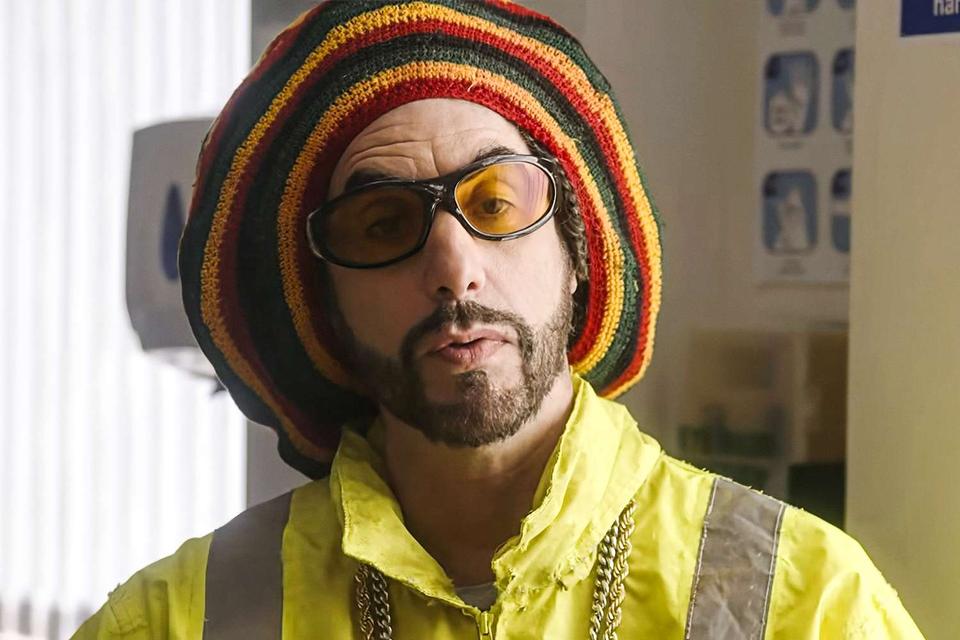
Ali G: Who Iz I? opens in cinemas on Friday amid calls for a boycott and accusations that the character relies on racial stereotypes.
Actor and comedian Sacha Baron Cohen has explained why he brought Ali G back, more than a decade after the character last appeared. In a cover essay for Time, published on Tuesday, he wrote: "The fact that Ali G is outdated and problematic is the very reason I resurrected him." The character first appeared on Channel 4.
The essay comes ahead of Ali G: Who Iz I?, a film Baron Cohen co-wrote, directed, produced and stars in. It is his feature directorial debut and opens in cinemas on Friday, 23 October. Morgana Robinson plays Julie, Ali G's girlfriend. Little is known about the plot beyond the character learning that Julie is pregnant and travelling to America to interview unsuspecting real-world participants, including American physicist Alan Lightman and retired Army General C Stewart Rodeheaver.
In the essay, Baron Cohen argues that the world Ali G has returned to is "in many ways, worse than the one he left 20 years ago." He points to the spread of bigotry: "Now, those views have gone mainstream," he wrote, citing fans hurling slurs at Black players during the World Cup and white nationalists marching through Washington, D.C., on July 4.
On the character itself, he wrote that he has always used his comedy to expose bias, and called Ali G "a white imbecile." The character, he says, is the target of the joke:
"The joke is on him, and on the predominantly white male establishment"
Critics see the character differently. Labour MP Paulette Hamilton called the character racist while discussing the trailer on the Jeremy Vine show, and said she believed Baron Cohen would not get away with portraying any other racial group "in the way he has done with the black community". Singer and presenter Jordan Stephens has posted multiple TikToks criticising the franchise's return. Earlier this year, the news comparison site NewsCord launched a campaign calling on cinemas to boycott the film, claiming 37,658 emails had been sent in support of it.
The controversy is not new. When Ali G Indahouse was released in 2002, protesters gathered at its Leicester Square premiere, and organiser Peter Akinti called the character the "new Al Jolson", a 1920s entertainer who performed in blackface. Comedian Dane Baptiste, the first black British comic nominated for an Edinburgh Comedy Award, recalls hearing the catchphrases everywhere in the character's heyday. "A lot of the time, I would hear people using phrases like 'Is it because I is black?' or 'Booyakasha'," he says.
The character has defenders too. Colton Dunn, one of the film's black writers, said: "From my point of view, Ali G is not a racist character. Ali G is a tool to expose racists." In Staines, Alex Balkan, who campaigned for a statue of Ali G in the town, says the character remains a source of local pride. "Everyone knows about us because of Ali G, and many of us wear that as a badge of pride," he says. Politician Sir Jacob Rees-Mogg, one of the character's most famous prank victims, posted on social media: "It is clever, satirical humour which makes the country, and many of us look foolish, and that's no bad thing."
At the film's recent premiere, Baron Cohen, in character, was asked by Variety about the Paramount-Warner Bros. merger. He replied: "The only merger that's happening tonight is me and Sydney Sweeney's babylons." The remark drew criticism on social media, with some viewers asking whether this style of humour still has a place in 2026.
Picturehouse, a British cinema chain with 25 local venues nationwide, had earlier told Metro that it had "no plans" to screen the film when it comes out. Its website seems to back this up, with no showings currently bookable.
No comments yet