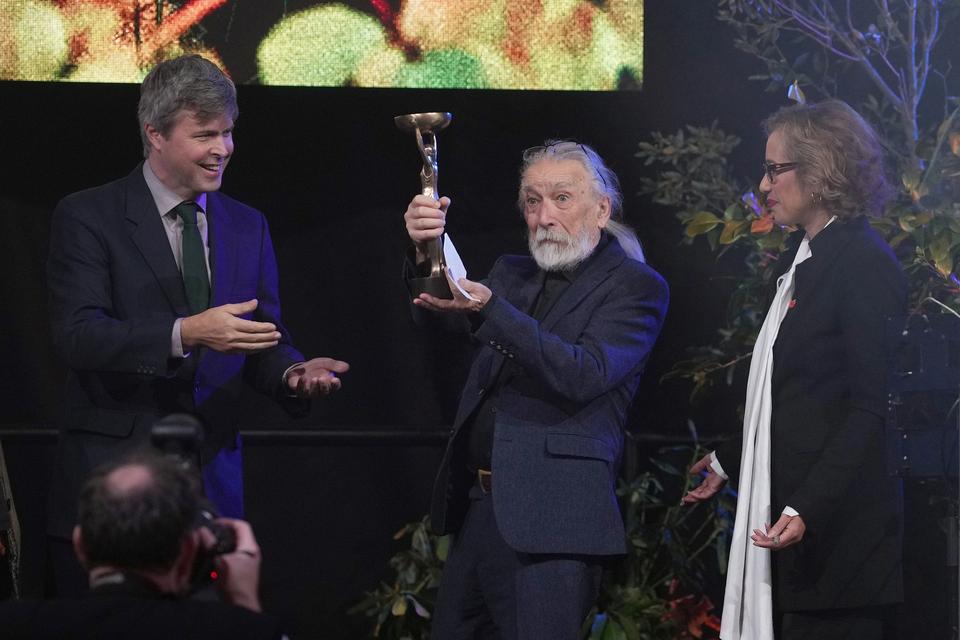
The sci-fi novel beat Marlon James and Douglas Stuart, both former winners, to the £50,000 prize.
The 2026 Booker Prize has gone to Briton M John Harrison, whose post-apocalyptic book The End of Everything won it. At 81, he is the oldest author to win the prize, overtaking Margaret Atwood, who was 79 when she shared the 2019 award with Bernardine Evaristo. The winner was announced at a ceremony at Old Billingsgate in London on Monday, 9 November. Harrison takes home £50,000.
Harrison beat five other finalists. The betting market's favourites were Marlon James and Douglas Stuart, both former winners, and the rest of the shortlist was Elizabeth Strout, Luke Kennard and Rebecca Perry.
Dame Mary Beard, who chaired the judges, said the decision was unanimous. "It's a challenging read, but some of the best fiction is challenging," she said of the book.
According to The Guardian, it is the first science fiction novel to win the prize in its 58-year history, while CNN says it could be considered the first. Booker Prize chief executive Gaby Wood said Harrison is "the first Booker winner to have emerged from the bona fide SF world". Asked whether he felt vindicated, Harrison said: "My problem has always been that I don't believe in genre."
The story is set after an unexplained disaster and the arrival of mysterious alien beings. It follows Phillip, a 38-year-old beachcomber, and his aunt Marnie, a 70-year-old artist with dementia, on the south-east English coast.
Harrison has said: "The End of Everything is about trying to live as if nothing has gone wrong. It's a disaster story in which the disaster is the failure to comprehend." He told The Guardian: "I could explain some of it to you," and then, "But no, I don't want to."
The novel grew out of the 2007-8 financial crisis. Harrison wrote something about the financial crisis, put what he had written in a drawer, and in 2015 reworked it into a short story called The Crisis. Writing the novel stretched over roughly fifteen years, with real-world events overtaking its author along the way.
Before the result, Bea Carvalho, head of books at Waterstones, said the shortlist had produced a week-on-week uplift of over 1,500 per cent through the chain on announcement, with The End of Everything seeing the highest rise, at 740 per cent. The win is also the first for independent publisher Serpent's Tail, whose last title on the shortlist was in 2014.
Harrison described his reaction as he accepted the award:
"You talk glibly about your life being changed, but it's weird when it happens. I feel like a proper writer at last, totally lacking in confidence."
Harrison has spoken before about feeling sidelined by the literary establishment. In a Telegraph interview earlier this month, he said: "I spent 40 or 50 years having a lot of anxieties I didn't need to have, which would've been obviated by having a little bit of success."
On Tuesday, Harrison told the Today programme on BBC Radio 4 that he had "wanted to write a book which really satirised the present-day barrage of information that we all suffer, without the necessary tools to understand what we're hearing and to analyse it and to have critical thinking about it".
Asked whether he feels hopeful for humanity, Harrison replied: "No, I don't feel any hope at all."



No comments yet